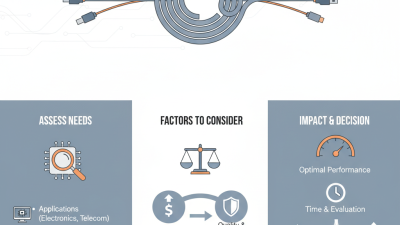
2026 Best Custom Cable Manufacturers for Global Buyers?
Choosing the best custom cable manufacturer in 2026 requires more than comparing catalog prices. Global buyers need verified engineering capability, stable supply, documented testing, and clear communication across borders.
Industry reports support this demand. Grand View Research’s Cable Assembly Market report identifies industrial automation, telecommunications, automotive systems, and medical equipment as important growth areas. MarketsandMarkets also highlights rising demand for application-specific cable assemblies, especially where compact designs and reliable signal transmission matter. These findings sound promising, but market growth does not guarantee supplier quality.
Cable performance begins with details. A factory floor, an automated crimping station, and a technician checking conductor pull force can reveal more than a polished website. Buyers should review drawings, insulation materials, connector sourcing, shielding methods, environmental testing, and production traceability. UL, RoHS, REACH, and IPC/WHMA-A-620 alignment may also influence qualification decisions.
As signal-integrity expert Dr. Howard Johnson wrote, “High-speed digital design is really analog design.” His observation applies directly to custom cable selection. A cable may look simple, yet impedance, bend radius, grounding, and termination quality can determine whether a system performs reliably.
This guide evaluates leading manufacturers for global buyers through a practical lens. It considers customization depth, prototype support, quality systems, export experience, testing resources, and long-term capacity. No ranking is perfect. Supplier information changes, regional strengths differ, and the lowest quote can hide costly revisions. That is why this comparison focuses on evidence, not impressive claims.

Define 2026 Cable Needs: USB4 Version 2.0 Supports 80 Gbps and USB PD 3.1 240 W
For global buyers, 2026 cable selection starts with real device requirements. The USB-IF USB4 Version 2.0 specification supports data rates up to 80 Gbps. It also permits asymmetric operation, reaching 120 Gbps in one direction under defined conditions. That speed demands controlled impedance, accurate shielding, strong connector retention, and verified cable length. Marketing labels alone are not enough.
USB Power Delivery 3.1 raises the ceiling to 240 W through 48 V and 5 A operation, according to the USB-IF technical specification. High-power custom cables need suitable electronic marking, thermal testing, and stable contact resistance. A manufacturer should provide test records for voltage drop, temperature rise, signal loss, and bending cycles. Keep the test evidence traceable. A report from the International Data Corporation also shows continued growth in connected PCs, monitors, and peripherals, increasing demand for one-cable data and power solutions. Yet forecasts can hide an uncomfortable issue: not every 80 Gbps cable can safely deliver 240 W. Buyers should specify both functions separately, then verify them together. A sample may pass once. It may fail after repeated flexing.
2026 Cable Capability Targets
USB4 Version 2.0 supports up to 80 Gbps of data throughput, while USB Power Delivery 3.1 supports up to 240 W of power delivery. These specifications help global buyers evaluate bandwidth, charging capacity, thermal design, connector quality, and certification requirements when selecting custom cables.
Screen Manufacturers Using IPC/WHMA-A-620, ISO 9001, and Full Traceability
2026 Best Custom Cable Manufacturers for Global Buyers?
When screening custom cable manufacturers, ask for evidence, not polished claims. IPC/WHMA-A-620 defines practical acceptance criteria for cable and wire harness assemblies. It covers crimping, soldering, insulation, routing, labeling, and workmanship. Qualified inspectors should show training records and inspection samples. A certificate alone is not enough.
ISO Survey 2023 recorded 1,265,216 ISO 9001 certificates worldwide. That figure shows the standard’s broad adoption, but certification does not guarantee every assembly is defect-free. Buyers should review process maps, calibration records, corrective-action reports, and audit findings. Strong manufacturers can trace each cable to materials, operators, tools, inspection results, and shipment dates. A barcode linked to a digital lot record is useful. So is a retained first-article sample.
McKinsey’s Global Supply Chain Leader Survey found that 73% of companies faced supplier-related problems during recent disruptions. Traceability helps locate affected lots faster. It also supports controlled substitutions when components become unavailable. Ask whether engineering changes require approval before production. Ask how rejected terminals are isolated. Small details matter.
There is room for honest imperfection. No factory avoids every crimp variation or documentation mistake. Reliable suppliers detect issues early, record them clearly, and improve the process. Global buyers should compare recent audit evidence, not only promised capabilities.
Verify Materials and Compliance: EU RoHS Restricts 10 Hazardous Substances
For global buyers in 2026, custom cable selection should begin with material verification, not attractive pricing. EU RoHS restricts ten hazardous substances in applicable electrical and electronic products, including cables. The list covers lead, mercury, cadmium, hexavalent chromium, PBB, PBDE, DEHP, BBP, DBP, and DIBP. Small percentages matter. A black PVC jacket may look identical across suppliers, yet its plasticizer package can differ.
Ask each manufacturer for a controlled bill of materials, supplier declarations, and recent test reports. Reports should identify the exact cable construction, revision, laboratory, method, and sample date. Vague statements such as “RoHS approved” provide weak evidence. Check copper plating, insulation, jacket, connectors, solder, labels, and overmolding separately. Request XRF screening for metals, followed by targeted chemical testing when risks or material changes justify it. Keep batch numbers linked to incoming inspection records.
Experienced buyers also review change-control procedures. A compliant sample can become noncompliant after a resin, pigment, or connector substitution. Ask how the factory freezes specifications and informs customers before production changes. This is where audits reveal gaps. Paperwork is not production control. I have seen good reports paired with poorly labeled samples, creating avoidable doubt. Verify accredited testing, but do not outsource judgment. Confirm that declarations match the destination market, product category, and current technical file. Keep an approved golden sample for comparison. It helps, though it is not perfect.
| Verification Dimension | Material or Compliance Item | Requirement or Benchmark | Evidence Global Buyers Should Request | Assessment Result |
|---|---|---|---|---|
| EU RoHS Substance Limits | ||||
| Restricted substance | Lead (Pb) | Maximum 0.1% by weight | Material declarations and test reports covering conductor plating, PVC or other insulation, shielding, terminals, connectors, and soldered parts. | Pass when verified |
| Restricted substance | Mercury (Hg) | Maximum 0.1% by weight | Supplier declaration supported by laboratory testing for applicable metal, coating, and component materials. | Pass when verified |
| Restricted substance | Cadmium (Cd) | Maximum 0.01% by weight | Homogeneous-material test results for plating, pigments, stabilizers, contacts, and molded cable components. | Pass when verified |
| Restricted substance | Hexavalent chromium (Cr VI) | Maximum 0.1% by weight | Coating and surface-treatment declarations plus appropriate analytical test data. | Pass when verified |
| Restricted substance | Polybrominated biphenyls (PBB) | Maximum 0.1% by weight | Flame-retardant declarations and test reports for insulation, jackets, connector housings, and molded parts. | Pass when verified |
| Restricted substance | Polybrominated diphenyl ethers (PBDE) | Maximum 0.1% by weight | Flame-retardant composition records and laboratory evidence for polymeric materials. | Pass when verified |
| Restricted substance | Bis(2-ethylhexyl) phthalate (DEHP) | Maximum 0.1% by weight | Plasticizer declarations and test reports for flexible PVC insulation, jackets, grommets, and strain-relief parts. | Pass when verified |
| Restricted substance | Benzyl butyl phthalate (BBP) | Maximum 0.1% by weight | Plasticizer composition data for flexible polymer materials and finished cable assemblies. | Pass when verified |
| Restricted substance | Dibutyl phthalate (DBP) | Maximum 0.1% by weight | Supplier material declarations and targeted testing of PVC compounds and flexible components. | Pass when verified |
| Restricted substance | Diisobutyl phthalate (DIBP) | Maximum 0.1% by weight | Plasticizer declarations, bill-of-material traceability, and testing of applicable polymeric materials. | Pass when verified |
| Manufacturer and Product Verification | ||||
| Legal applicability | RoHS scope review | Confirm whether the finished cable or cable assembly is electrical or electronic equipment within the scope of Directive 2011/65/EU, as amended. | Written scope assessment identifying the product category, destination market, rated voltage, intended use, and any applicable exemption. | Documented review required |
| Test method | Analytical testing | Testing should use recognized methods from the IEC 62321 series, with results reported against homogeneous-material limits. | Current laboratory report showing sample identification, test method, detection limits, laboratory details, and test date. | Check report quality |
| Material traceability | Homogeneous materials | Evaluate separable materials independently, such as copper, plating, insulation, shielding foil, braid, jacket, connector, and solder. | Bill of materials, material codes, supplier declarations, change-control records, and lot-level traceability. | Traceability required |
| Declaration control | EU Declaration of Conformity | The responsible economic operator should maintain a signed declaration when the product is subject to applicable EU requirements. | Signed declaration identifying the product, applicable legislation, responsible entity, date, and authorized signatory. | Verify before shipment |
| Production consistency | Change management | Material substitutions, insulation compound changes, plating changes, and connector changes must trigger compliance review. | Engineering-change procedure, approved-material list, notification period, and re-test criteria. | Contractual control advised |
| Quality system | Process and inspection controls | Incoming-material inspection, first-article approval, in-process checks, final inspection, and nonconformance handling should be defined. | Quality manual, inspection plan, sample records, corrective-action reports, and calibration records. | Audit evidence required |
| Custom-cable capability | Specification control | Confirm conductor size, strand construction, insulation material, jacket rating, shielding, bend radius, connector pinout, and operating environment. | Controlled technical drawing, approved samples, test specification, and signed golden-sample record. | Approve before mass production |
| Market documentation | Technical file retention | Compliance evidence should be retained for the legally required period applicable to the product and market. | Technical file index containing drawings, BOM, risk assessment, declarations, test reports, and production records. | Confirm retention process |
| Note: RoHS limits apply to each homogeneous material, not simply to the finished cable by total weight. The limits shown are the standard maximum concentration values by weight: 0.1% for nine restricted substances and 0.01% for cadmium. Applicable exemptions and product-specific legal requirements must be checked separately before placing an order. | ||||
Audit Production Quality with IEC 60512 Continuity, Hi-Pot, and Impedance Tests
Custom cable sourcing often fails at the test bench, not the drawing table. A reliable manufacturer should show how each cable matches its approved specification. During an audit, request applicable IEC 60512 test methods, calibration records, operator instructions, and sampled production data. Do not accept a generic “passed” statement. Reports should identify cable length, conductor layout, test voltage, duration, limits, and results.
Continuity testing follows the current path from pin to pin. A fixture can expose open circuits, crossed conductors, and unstable crimp contacts. Watch the operator test both ends, especially on dense multi-core assemblies. Hi-pot testing applies controlled voltage between conductors, insulation, or shield layers. It helps reveal breakdown risks, damaged jackets, and weak separation. Safety controls matter. Enclosures, interlocks, discharge time, and clear records should be visible.
For high-speed cable assemblies, impedance checks deserve equal attention. Relevant IEC 60512 transmission tests can identify mismatches that cause reflections, signal distortion, or intermittent data loss. Compare measured values across the required frequency range, not just one convenient point. Production quality also depends on repeatability. Request results from early, middle, and late batches. A clean report is not proof of a stable process. I would still inspect samples, review failed units, and ask why rework occurred. That uncomfortable question often reveals more than a certificate.
Compare MOQ, Tooling, Lead Time, PPAP, and Landed Cost for Global Sourcing
2026 Best Custom Cable Manufacturers for Global Buyers?
Compare MOQ, Tooling, Lead Time, PPAP, and Landed Cost for Global Sourcing
Selecting a custom cable manufacturer requires more than comparing unit prices. A low quote may hide tooling charges, testing fees, import duties, or expensive air freight. Experienced buyers should request a detailed cost sheet before approving samples.
MOQ affects inventory risk. Some manufacturers accept 500 pieces, while others require 2,000 pieces. Tooling may cost more for complex overmolding, unusual connectors, or tight bend radii. Confirm whether tooling belongs to you and whether maintenance fees apply. Lead time should include drawing approval, prototype production, testing, and final inspection. A quoted 20-day production period may exclude material purchasing.
PPAP capability matters for automotive and industrial programs. Ask for dimensional reports, material certificates, process flow charts, control plans, and capability studies. Not every supplier prepares these documents with equal discipline. Review sample reports carefully.
Tips: Send a complete drawing, annual demand estimate, packaging requirement, and delivery location. Request both EXW and landed-cost estimates. Check customs classification, insurance, duty, and local handling charges. Compare identical specifications.
My sourcing reviews often show that the cheapest factory is not the cheapest option. A spreadsheet can still mislead. One missed connector tolerance caused a costly redesign in a previous project. Approve pilot samples, inspect first-article parts, and test cables under real temperature, vibration, and bending conditions. Recovery is harder than prevention.
Related Posts
-
How to Choose the Right Custom Cable for Your Needs?
-

Top Custom Cable Solutions for Global Buyers Today?
-

10 Essential Tips for Choosing the Right Custom Cable for Your Needs?
-

10 Essential Tips to Choose the Best Cable Supplier for Your Business Needs
-

10 Essential Tips for Choosing the Right Cable Supplier for Your Business Needs
-

2026 Best Cable and Wire Options What Should You Choose?